Basics
Start developing with C#
The essentials:
-
C# was developed in 2000 by Anders Hejlsberg, who works at Microsoft.
-
C# code is compiled into a format called Common Intermediate Language (CIL).
When you start writing C# and search online, you’ll often see terms like "MSIL", "ILC", or just "IL". All of them refer to the same thing — but the official name is Common Intermediate Language, or CIL for short.
To write C# code, we need a program (a compiler) that can read our source code and translate it into something the computer can work with — essentially binary (1s and 0s). This compiler reads the code we write (top to bottom) and converts it into CIL.
After that, the CLR (Common Language Runtime) steps in. The CLR is part of the .NET platform, and it translates the CIL code into native machine code so the computer can run it.
- If you want to learn more about it, start here: https://en.wikipedia.org/wiki/Common_Intermediate_Language
Disclaimer: When you start diving deeper into how this works, it can become a rabbit hole.
You might end up spending a lot of time trying to understand what compilers do, how they differ, and so on.
For most people, it’s enough to get a “helicopter view” of what the compiler does — more details will come naturally as you keep learning.
So, here's an overview of how it works:

The essentials of the .NET Platform
-
C# is the main language most developers use for .NET projects, but you can also use Visual Basic or F#. However, do not use Visual Basic for modern development. Microsoft just recently announced they will not continue to develop Visual Basic anymore.
-
The ".NET Framework" is now generally referred to as the .NET platform or .NET Core in Microsoft documentation and online resources.
This can be one of the most confusing parts for newcomers — you'll see ".NET" mentioned everywhere, combined with other terms like ASP.NET, .NET Framework, Console Application in .NET, WPF .NET, and so on.
But luckily, as of 2022, Microsoft has unified everything under a single platform. .NET Core and the .NET platform are now the same thing.
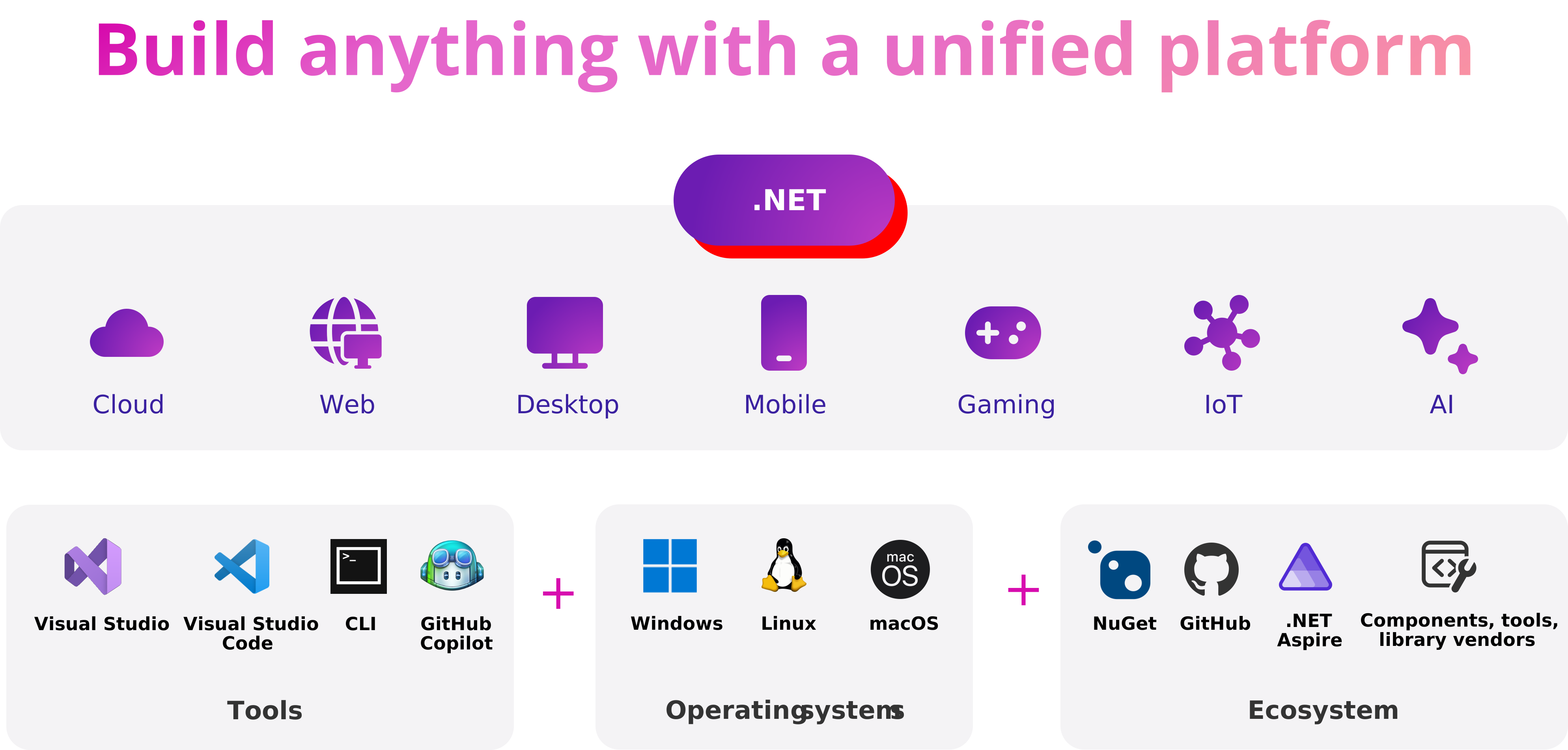
Microsoft’s idea was to build a core runtime and extend everything else on top of it — web, desktop, mobile, cloud, and more. Today, you can run .NET on any operating system — Windows, macOS, Linux, iOS, Android, etc.
So when we say .NET is cross-platform, we really mean it.
How to think about it:
- .NET is the base platform.
The are multiple framework within the .NET platform.
For example:
ASP(.NET) (Active Server Pages) - Web development
WPF(.NET) (Windows Presentation Foundation)
MAUI(.NET) (Multi-platform App UI)
Xamarin(.NET) (Cross-platform mobile development) - Was bought by Microsoft and is now known as MAUI.
Blazor(.NET) (Web development)
WinForms(.NET) (Building Desktop Applications)
You can start with a simple .NET Console Application (e.g., using .NET 9) and expand it into a web API, a desktop app, or anything else.
The .NET platform consists of many smaller projects. Here's a high-level overview from Microsoft:
Microsoft commits to maintaining and supporting LTS versions for longer periods, making them ideal for production use.
-
Microsoft releases a new .NET version every year. Every second version is typically marked as an LTS release.
-
Major changes were introduced starting with .NET 5. Before that, .NET was very Microsoft-centric and not ideal for developing cross-platform apps. That changed with the unified platform.
Syntax
How to write C#
- C# includes built-in types like:
int,string,bool,char,float,double
Examples: